
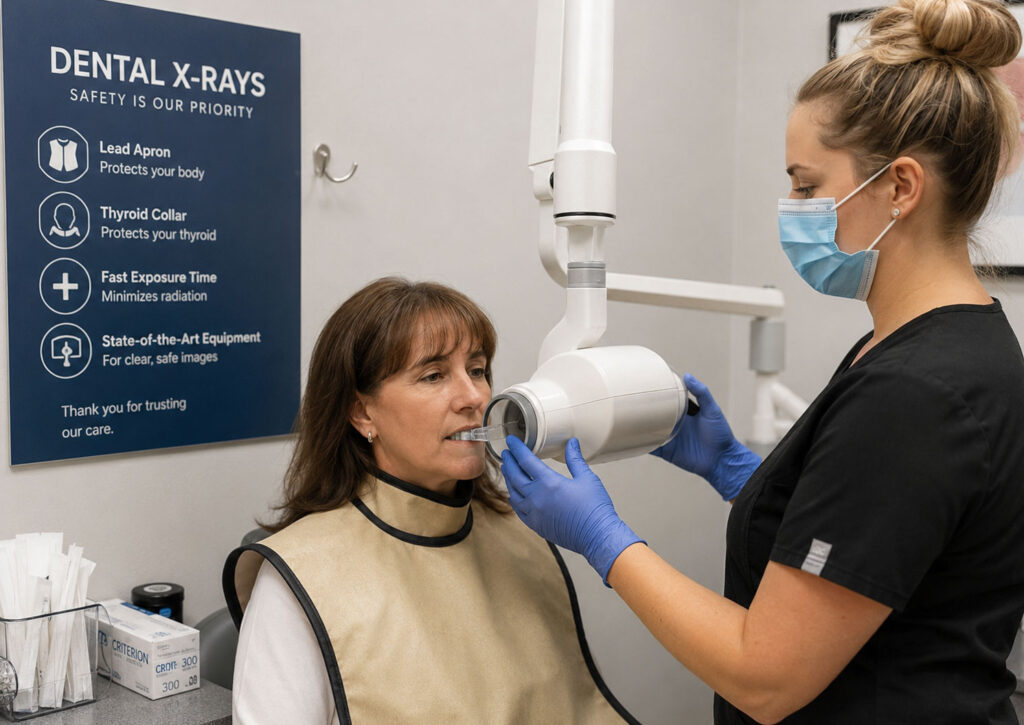
Starting a career as a dental assistant can be an excellent option for people who want to enter the healthcare field without completing a four-year college degree. Dental assistants work directly with patients, support dentists during treatment, prepare dental instruments, maintain infection-control standards and help dental offices operate efficiently.
Before enrolling in a dental assistant program, however, prospective students should understand the requirements that apply in Virginia.
Questions commonly asked by future students include:
- Do dental assistants need a license in Virginia?
- Is dental assistant school required?
- Can a Dental Assistant I take X-rays?
- Is CPR certification mandatory?
- What is the difference between a Dental Assistant I and Dental Assistant II?
- Is a school certificate the same as national certification?
The answers are not always straightforward because Virginia treats entry-level dental assisting, dental radiography and advanced Dental Assistant II registration as separate matters.
This guide explains the dental assistant requirements in Virginia and outlines a practical path for students interested in starting a dental assisting career in Lorton, Woodbridge, Springfield, Alexandria and other Northern Virginia communities.
Do Dental Assistants Need a License in Virginia?
Virginia recognizes two primary levels of dental assistants:
- Dental Assistant I
- Dental Assistant II
A Dental Assistant I is generally an entry-level dental assistant who works under the direction of a dentist or dental hygienist. Virginia does not issue a separate professional license or registration for Dental Assistant I workers.
A Dental Assistant II is an advanced dental assistant who is registered by the Virginia Board of Dentistry. Dental Assistant II workers may perform certain reversible intraoral procedures under the direction and direct supervision of a dentist.
This distinction is important because completing an entry-level dental assistant program does not automatically make someone a Dental Assistant II.
Most new dental assistants begin their careers at the Dental Assistant I level. They may later pursue national certification, additional education and Dental Assistant II registration as they gain experience.
What Does a Dental Assistant I Do?
A Dental Assistant I typically supports the clinical and administrative operations of a dental practice.
Depending on the assistant’s training, experience and level of supervision, common responsibilities may include:
- Preparing treatment rooms before procedures
- Seating and dismissing patients
- Reviewing and updating patient information
- Preparing dental instruments and materials
- Passing instruments to the dentist
- Using dental suction equipment
- Keeping the treatment area clean and organized
- Disinfecting operatories between patients
- Packaging and sterilizing dental instruments
- Maintaining sterilization records
- Managing dental supplies
- Helping document treatment
- Providing instructions approved by the dentist
- Assisting with appointment scheduling
- Coordinating laboratory cases
- Taking dental X-rays after meeting Virginia’s radiation requirements
The exact duties assigned to an assistant depend on Virginia law, the supervising dentist, the procedure being performed and the assistant’s demonstrated training and competence.
Some duties are reserved for licensed dentists, dental hygienists or registered Dental Assistant II workers. An assistant should never perform a procedure simply because another employee says, “We always do it this way.” Office habits do not override state regulations.
Is Dental Assistant School Required in Virginia?
Virginia does not require every entry-level Dental Assistant I to graduate from a specific dental assisting program before being employed.
That does not mean formal training is unnecessary.
A dental office is a healthcare environment where employees must understand infection control, radiation safety, patient privacy, dental terminology and clinical procedures. A new employee who has received no structured training may struggle to keep up in a busy practice.
Formal dental assistant training can help students develop the basic skills and confidence needed to apply for entry-level positions.
A quality dental assistant program should provide instruction in several important areas.
Dental Anatomy and Terminology
Dental assistants must understand the language used by dentists, hygienists and insurance coordinators.
Students should learn:
- Tooth numbers
- Tooth surfaces
- Types of teeth
- Basic oral anatomy
- Dental charting
- Common dental abbreviations
- Names of dental procedures
- Dental specialties
- Common oral conditions
For example, an assistant may be asked to prepare a room for a restoration on tooth number 30, take a periapical X-ray of tooth number 9 or set up for a crown preparation. Without basic dental terminology, it becomes difficult to follow instructions accurately.
Chairside Dental Assisting
Chairside assisting involves working directly beside the dentist during patient treatment.
Students should practice:
- Setting up procedure trays
- Preparing the patient
- Positioning the dental chair
- Passing instruments safely
- Using high-volume evacuation
- Using a saliva ejector
- Retracting the cheek or tongue
- Maintaining a clear operating field
- Anticipating the dentist’s next step
- Supporting patient comfort
- Cleaning the room after treatment
This coordinated method of working is commonly called four-handed dentistry because the dentist and assistant work together as a team.
A good assistant does more than hand instruments to the dentist. The assistant watches the procedure, anticipates what is needed and helps the appointment move safely and efficiently.
Infection Control and Sterilization
Infection control is one of the most important responsibilities in a dental office.
Dental assistants frequently handle contaminated instruments, disinfect treatment rooms and prepare instruments for sterilization. Poor technique can expose patients and employees to preventable risks.
Training should cover:
- Proper hand hygiene
- Personal protective equipment
- Surface barriers
- Operatory disinfection
- Instrument transportation
- Ultrasonic cleaning
- Instrument packaging
- Sterilizer loading
- Biological monitoring
- Chemical indicators
- Sterilization records
- Sharps safety
- Exposure-control procedures
- Clinical waste disposal
Students should understand the difference between cleaning, disinfection and sterilization. These terms are not interchangeable.
Cleaning removes debris. Disinfection reduces or destroys many disease-causing microorganisms on surfaces. Sterilization destroys all forms of microbial life on properly processed instruments.
Dental Materials
Dental assistants may prepare or handle materials used during fillings, crowns, impressions and other procedures.
Training may include:
- Alginate impression material
- Dental stone and gypsum
- Temporary restorative material
- Dental cement
- Etching material
- Bonding agents
- Composite material
- Liners and bases
- Temporary crowns
- Bite-registration material
Dental materials must often be mixed or handled within a specific amount of time. Preparing the wrong material or mixing it incorrectly can delay treatment and create unnecessary waste.
Students should learn not only what each material is called, but also when it is used and how it should be prepared.
Patient Communication and Professionalism
Dental assistants spend a significant amount of time with patients.
They may be the first clinical team member a patient sees and the last person the patient speaks with before leaving the office.
Important communication skills include:
- Greeting patients professionally
- Confirming the patient’s identity
- Reviewing health-history information
- Explaining what will happen during an appointment
- Recognizing patient anxiety
- Protecting patient privacy
- Listening carefully
- Communicating concerns to the dentist
- Giving only instructions approved by the dentist
- Maintaining appropriate professional boundaries
Dental assistants should not diagnose conditions, promise insurance coverage or provide treatment advice beyond their authorized role.
When a patient asks a question outside the assistant’s scope, the correct response is to refer the question to the dentist or appropriate team member.
Dental X-Ray Requirements in Virginia
Dental radiography is one of the most useful qualifications an entry-level dental assistant can obtain.
Dental X-rays help dentists identify problems that may not be visible during a clinical examination, including cavities between teeth, bone loss, infections and impacted teeth.
Virginia regulates who may place and expose dental radiographs.
Under Virginia regulations, neither a Dental Assistant I nor a Dental Assistant II may take dental radiographs unless the assistant has completed one of the state’s approved qualification pathways.
Virginia currently recognizes the following pathways:
- Successful completion of a radiation-safety course and examination through an institution that maintains a dental assisting, dental hygiene or dentistry program accredited by the Commission on Dental Accreditation.
- Certification through the American Registry of Radiologic Technologists.
- Successful completion of the Radiation Health and Safety Review Course provided by the Dental Assisting National Board or its affiliate, followed by passage of the DANB Radiation Health and Safety examination.
Any radiation certificate issued under this Virginia regulation must be posted where patients can plainly see it.
Can a Dental Assistant I Take X-Rays in Virginia?
Yes.
A Dental Assistant I may take dental X-rays after meeting one of Virginia’s approved radiation-certification pathways.
The assistant does not need to become a registered Dental Assistant II solely to take radiographs.
This is one of the most commonly misunderstood parts of Virginia dental-assisting regulations.
Dental Assistant II is an advanced registration related to expanded reversible intraoral procedures. It should not be confused with basic dental radiation certification.
Is General X-Ray Training Enough?
Not necessarily.
A dental assistant program may include classroom instruction and hands-on practice in dental radiography. However, students should verify that the program also connects them to a pathway that satisfies Virginia’s legal requirements.
Prospective students should ask the school:
- Which Virginia-approved radiation pathway is included?
- Who provides the radiation-safety course?
- Which examination will students take?
- Is the examination fee included in tuition?
- Does the school help students register for the examination?
- Is hands-on sensor-positioning practice included?
- What happens if a student does not pass?
- What certificate will the student receive?
- Does that certificate satisfy current Virginia regulations?
A vague statement such as “X-ray training is included” is not enough. Students should ask for the exact name of the course, examination and certificate.
What Do Students Learn in Dental Radiography?
Dental radiography training commonly includes:
- How dental X-rays are produced
- Radiation safety principles
- Patient protection
- Operator protection
- Proper use of barriers
- Infection control during radiography
- Sensor and film positioning
- Bitewing radiographs
- Periapical radiographs
- Full-mouth series
- Panoramic imaging
- Common positioning errors
- Image quality
- Retake prevention
- Equipment care
- Documentation
Students should also learn the ALARA principle, which means keeping radiation exposure “as low as reasonably achievable.”
Proper positioning is important because poorly positioned images may not show the area the dentist needs to evaluate. Unnecessary retakes create additional radiation exposure and slow down the appointment.
What Is the DANB RHS Exam?
DANB stands for the Dental Assisting National Board.
The Radiation Health and Safety examination, commonly called the RHS exam, is one of the examinations offered by DANB. It tests a candidate’s understanding of dental radiography and radiation safety.
As of July 2026, DANB lists the RHS exam as containing 75 questions with 60 minutes of testing time.
Topics may include:
- Radiation safety
- Patient protection
- Operator protection
- X-ray equipment
- Image production
- Exposure procedures
- Image-processing concepts
- Infection control
- Image errors
- Quality assurance
Students should review the current DANB candidate handbook before registering because examination fees, scheduling procedures and testing policies can change.
Is CPR Certification Required for Dental Assistants in Virginia?
The answer depends on the position or credential being discussed.
Virginia’s regulations specifically require a registered Dental Assistant II to maintain evidence of a current hands-on basic cardiopulmonary resuscitation course when renewing registration.
The Virginia provisions discussed here do not state that every Dental Assistant I must hold CPR certification simply to work under the Dental Assistant I category.
However, many dental employers prefer or require CPR or Basic Life Support certification.
CPR training is valuable because medical emergencies may occur in a dental office. Examples include:
- Fainting
- Chest pain
- Breathing difficulty
- Allergic reactions
- Choking
- Seizures
- Low blood sugar
- Cardiac arrest
- Reactions to medications
- Complications related to existing medical conditions
A dental assistant may be responsible for alerting the dentist, retrieving emergency equipment, calling emergency services or helping the clinical team respond.
CPR vs. Basic Life Support
A standard CPR course teaches how to respond to cardiac arrest and breathing emergencies.
Basic Life Support, commonly called BLS, is designed for healthcare professionals and usually includes:
- Adult CPR
- Child CPR
- Infant CPR
- Rescue breathing
- Automated external defibrillator use
- Choking response
- Two-rescuer CPR
- Team-based emergency response
Students seeking dental employment should generally choose a hands-on CPR or BLS course that meets the requirements of their employer or credentialing organization.
An online-only course may not satisfy a requirement that specifically calls for hands-on skills training.
Dental Assistant Certificate vs. Certification
The terms certificate and certification are often used as though they mean the same thing. They do not.
Dental Assistant Program Completion Certificate
A program completion certificate is issued by a school after a student successfully completes its dental assistant curriculum.
It documents completion of that specific training program.
A school certificate does not automatically mean that the graduate:
- Holds a state license
- Is registered as a Dental Assistant II
- Is nationally certified
- Is legally qualified to take dental X-rays
- Is guaranteed employment
Those qualifications have separate requirements.
Dental Radiation Certificate
A dental radiation certificate shows that the assistant completed an approved pathway for placing and exposing dental radiographs.
This certificate is separate from the general dental assistant program completion certificate.
National Dental Assistant Certification
National certification is a professional credential issued by a credentialing organization.
One widely recognized credential is DANB’s Certified Dental Assistant credential, commonly abbreviated as CDA.
Virginia requires a Dental Assistant II applicant to provide evidence of a current CDA credential or another qualifying national credential accepted by the Board. The credential must include examination in general chairside assisting, radiation health and safety and infection control.
A student should not assume that completing a short dental assistant course automatically creates eligibility for the CDA credential. DANB has separate education, experience, CPR and examination requirements.
What Is a Dental Assistant II?
A Dental Assistant II is an advanced dental assistant registered by the Virginia Board of Dentistry.
Dental Assistant II workers operate under the direction and direct supervision of a dentist and may perform authorized reversible intraoral procedures.
Dental Assistant II registration is not normally the first step for someone entering dental assisting. It is an advanced career path for assistants who complete the required credentials and education.
Virginia maintains a formal application process for Dental Assistant II registration through the Board of Dentistry.
To maintain registration, Dental Assistant II workers must keep their qualifying national certification current and maintain evidence of current hands-on basic CPR training.
A Practical Path to Becoming a Dental Assistant in Virginia
The path will vary depending on a student’s goals, but many entry-level candidates follow these steps.
Step 1: Earn a High School Diploma or GED
Most dental assistant programs and employers expect applicants to have completed high school or obtained an equivalent credential.
A strong background in science, communication and basic computer skills can also be useful.
Step 2: Complete Dental Assistant Training
Choose a program that teaches:
- Dental anatomy
- Dental terminology
- Chairside assisting
- Infection control
- Sterilization
- Dental materials
- Radiography
- Patient communication
- Clinical documentation
- Office professionalism
Hands-on training is particularly important. Dental assisting cannot be learned effectively from reading alone.
Step 3: Complete an Approved Radiation Pathway
Students who want to take dental X-rays must complete one of Virginia’s approved radiation-certification pathways.
Confirm the pathway before enrolling rather than assuming every radiography class leads to legal qualification.
Step 4: Complete CPR or BLS Training
Although the specific entry-level Dental Assistant I provisions discussed here do not universally require CPR, obtaining hands-on CPR or BLS certification can improve employment readiness.
It may also be required by the employer, future national certification or Dental Assistant II registration.
Step 5: Apply for Entry-Level Positions
Entry-level dental assistants may find opportunities in:
- General dental offices
- Pediatric dental offices
- Orthodontic practices
- Oral surgery offices
- Endodontic practices
- Periodontal practices
- Prosthodontic practices
- Community dental clinics
- Public-health programs
The daily responsibilities may vary significantly by specialty.
Step 6: Build Clinical Experience
Dental assistants improve through repetition and supervised practice.
Work experience helps assistants become faster and more confident with:
- Room setup
- Instrument identification
- Suction
- Radiographs
- Sterilization
- Patient communication
- Procedure sequencing
- Dental materials
- Clinical documentation
Step 7: Consider National Certification
After meeting the applicable requirements, an assistant may choose to pursue national certification.
Certification may demonstrate professional knowledge and commitment, but candidates should review the current eligibility requirements before applying.
Step 8: Consider Dental Assistant II Registration
Assistants who want to perform advanced restorative and prosthetic functions may later pursue the credentials, education and registration required for Dental Assistant II status.
What Employers Look for in a Dental Assistant
A training certificate can help a candidate get an interview, but employers also evaluate professional behavior.
Dental offices commonly look for assistants who:
- Arrive on time
- Follow instructions
- Maintain patient confidentiality
- Communicate respectfully
- Accept constructive feedback
- Stay organized
- Follow infection-control procedures
- Remain calm during busy schedules
- Treat patients professionally
- Work well with the dental team
- Take responsibility for mistakes
- Continue learning
Dental assisting is fast-paced. A strong assistant must pay attention to details without losing sight of the overall appointment.
Clinical knowledge matters, but reliability is often what separates an average employee from a valuable team member.
How to Choose a Dental Assistant Program in Virginia
Students should compare more than the advertised tuition or program length.
Before enrolling, ask:
Is the school authorized to operate?
The school should clearly disclose its authorization, policies, tuition, program requirements and refund terms.
What level of employment does the program prepare students for?
Most short-term programs prepare students for entry-level Dental Assistant I employment.
A school should not suggest that graduates automatically become registered Dental Assistant II workers unless its training actually satisfies Virginia’s advanced requirements.
How much hands-on training is provided?
Students should practice real clinical skills, including:
- Instrument identification
- Tray setup
- Chairside transfer
- Suction
- Disinfection
- Sterilization
- Dental materials
- Impressions
- Radiographic positioning
- Patient preparation
Watching videos is useful, but it is not a substitute for supervised practice.
Is training conducted in a dental environment?
Training in an equipped dental setting can help students become familiar with:
- Dental chairs
- Delivery systems
- Operatories
- Sterilization areas
- Instruments
- X-ray equipment
- Laboratory materials
- Front-office workflow
Which X-ray pathway is included?
The school should identify the exact radiography course, examination and certificate.
Is CPR or BLS included?
Ask whether CPR training is provided, whether it includes hands-on skills and whether there is an additional charge.
What costs are not included in tuition?
Ask about:
- Registration fees
- Supplies
- Scrubs
- Textbooks
- Examination fees
- CPR fees
- Transportation
- Retesting fees
Does the school offer career assistance?
Career support may include:
- Resume preparation
- Interview practice
- Job-search guidance
- Employer referrals
- Professional communication training
- Assistance preparing for the first day of work
No legitimate school can guarantee every graduate a job. However, useful career support can help students present themselves more effectively to employers.
Dental Assistant Training at Career First Institute
Career First Institute offers a Dental Assistant Program in Lorton, Virginia.
The program includes 80 clock hours completed over 10 weeks. Students may select weekday evening classes or a Saturday schedule. Training takes place in an actual dental office while the practice is closed to patients.
Students receive exposure to:
- Dental treatment rooms
- Chairside assisting
- Sterilization areas
- Dental instruments
- X-ray equipment
- Laboratory space
- Front-desk operations
- Infection control
- Dental terminology
- Dental materials
The program combines classroom instruction with hands-on training and is designed to prepare students to seek entry-level employment as a dental assistant, sterilization technician or clinical assistant.
Career First Institute is located at:
9360 Richmond Highway
Lorton, Virginia 22079
Students should contact the school for current information about:
- Upcoming class dates
- Tuition
- Payment plans
- Supplies
- Radiation training
- Examination procedures
- CPR arrangements
- Enrollment requirements
Frequently Asked Questions About Virginia Dental Assistant Requirements
Do dental assistants need a license in Virginia?
Virginia does not issue a separate license or registration for entry-level Dental Assistant I workers. Dental Assistant II is an advanced category that requires registration with the Virginia Board of Dentistry.
Can I work as a dental assistant without attending school?
Virginia does not require every Dental Assistant I to graduate from a particular program. However, formal training can improve job readiness and help students understand clinical procedures, infection control and patient safety.
Can a Dental Assistant I take X-rays?
Yes. A Dental Assistant I may take dental X-rays after completing one of Virginia’s approved radiation-certification pathways.
Do I have to become a Dental Assistant II to take X-rays?
No. Dental Assistant II registration is not required solely for dental radiography.
Does completing a dental assistant program automatically qualify me to take X-rays?
Not necessarily. The assistant must complete one of Virginia’s approved radiation-certification pathways.
Is CPR required for every Dental Assistant I?
The Virginia provisions discussed in this article do not state that every Dental Assistant I must maintain CPR certification simply to work under that category. Employers may still require it.
Is CPR required for Dental Assistant II?
Yes. A Dental Assistant II must maintain evidence of a current hands-on basic CPR course for registration renewal.
Is a school certificate the same as DANB certification?
No. A school certificate documents completion of a specific training program. DANB certification is a separate national professional credential with its own eligibility and examination requirements.
Does graduating from a short dental assistant program make me a Dental Assistant II?
No. Dental Assistant II requires qualifying national credentials, advanced education and registration with the Virginia Board of Dentistry.
How long does Career First Institute’s dental assistant program take?
Career First Institute’s program consists of 80 clock hours completed over 10 weeks.
Are evening or weekend dental assistant classes available?
Career First Institute offers weekday evening options and a Saturday option.
Where is Career First Institute located?
Career First Institute is located at 9360 Richmond Highway in Lorton, Virginia.
Start Your Dental Assisting Career in Virginia
Becoming a dental assistant involves more than receiving a certificate.
Students should understand:
- The difference between Dental Assistant I and Dental Assistant II
- Which duties they may legally perform
- How Virginia dental X-ray certification works
- Whether CPR or BLS is needed
- The difference between school completion and national certification
- What employers expect from entry-level assistants
Career First Institute offers hands-on dental assistant training for students in Lorton and surrounding Northern Virginia communities.
The 10-week program is designed for students who want practical exposure to a real dental-office environment while preparing for entry-level employment.
Students from Lorton, Woodbridge, Springfield, Alexandria, Burke, Fairfax Station, Mount Vernon and nearby communities may contact Career First Institute for information about upcoming classes.
Call Career First Institute at (571) 348-0109 or apply through the Career First Institute website to begin the enrollment process.